
Why Your Till Is Short Every Evening — And It’s Not Always Theft
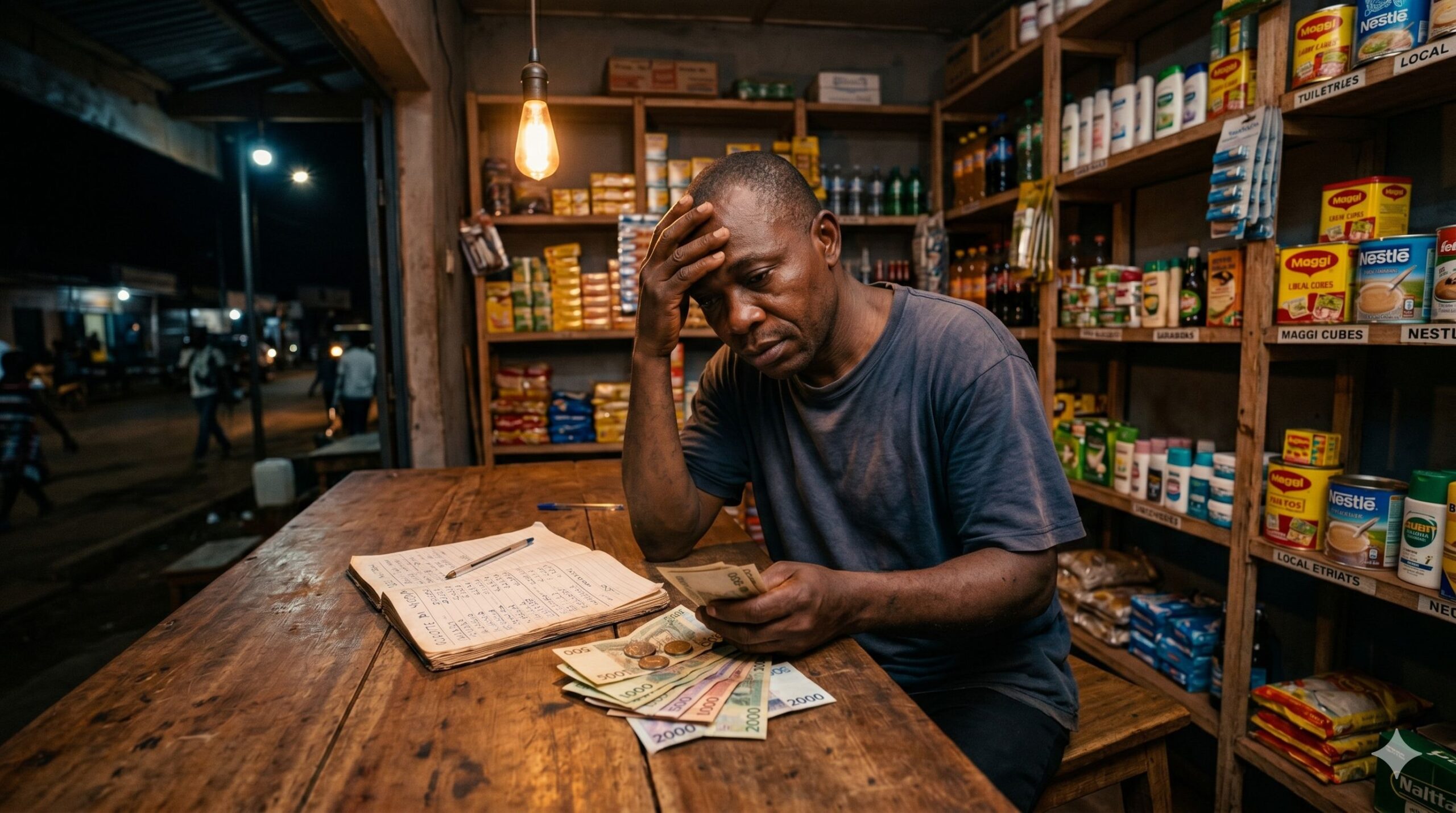
Every evening, after pulling down the shutter, you recount. And something is missing.
It’s not much. 2,000 FCFA yesterday. 3,500 the day before. Last week it was 8,000. You replay the day in your head. You reread the notebook. You recount the notes. Nothing clearly explains where the money went.
You start looking at your staff member differently. Maybe it’s him. Maybe it’s you who forgot to write something down. Maybe you gave the wrong change. Or maybe someone is stealing from you — slowly, intelligently, a little every day.
Every merchant in Africa knows this moment. It has a simple name: the shortage.
The shortage is not a mystery. It is a broken system.
Before looking for someone to blame, you need to understand an uncomfortable truth: in the vast majority of cases, the till shortage is not caused by deliberate theft. It is caused by a set of invisible flaws in the way you run your shop — flaws that nobody has ever clearly explained to you.
Here are the real causes, in order.
1. The silent calculation error
Your staff member serves 40 to 60 customers a day. For every customer, they mentally add up the items, calculate the total, give change. They do this in under a minute, under pressure, sometimes with several people waiting.
Errors are inevitable. An item missed in the addition. 500 FCFA too much change given on a 3,500 FCFA order. Two notes stuck together handed back as one. These errors are not bad faith — they are the mechanical result of mental arithmetic done too fast, too often.
Over a day of 50 transactions, a 300 FCFA error on just 5 of them creates a shortage of 1,500 FCFA. No theft. Just human arithmetic.
2. The unrecorded sale
The notebook is not filled in real time. Your staff member serves 3 customers in a row, then goes to record the sales. In between, a 4th customer came in. They bought two bars of soap. Your staff member collected 700 FCFA. But when it came time to write it down, they no longer remembered the 4th customer clearly. They record the other 3. The 4th disappears.
This is not theft. It is a memory lapse. And it happens several times a day in any shop that records its sales by hand.
3. Undetectable micro-fraud
This one exists too, and it needs to be addressed. It is different from classic till theft. The staff member does not take your notes from the cash drawer. It is more subtle than that.
They don’t declare one in every five sales. They collect the money, put it in their pocket, and if you ask, they say the customer didn’t buy much. Or they slightly inflate the price — the customer pays 1,200 FCFA instead of 1,000, the staff member records 1,000 FCFA in the notebook and keeps 200. Multiplied by 10 transactions a day, that’s 2,000 FCFA disappearing without you ever being able to prove it.
This form of fraud is hard to detect precisely because it leaves the notebook internally consistent. The only way to see it is to compare the notebook against the actual stock. And to do that, you need to know exactly what was sold.
4. The undeclared expense
Your staff member sent a young boy to buy bread for lunch. He took 500 FCFA from the till. He forgot to tell you. You may have done the same in the middle of the day — taken 2,000 FCFA to send something to your family. Neither of you recorded these outgoings.
At the end of the day, these small untracked movements create a gap between what should be in the till and what actually is.
5. The unregistered customer credit
Mrs Koné from the neighbourhood bought goods worth 4,500 FCFA. She only had 3,000 on her. She’ll pay the rest on Friday. Your staff member trusts her — she’s a regular. They record 4,500 FCFA in sales, but there are only 3,000 FCFA in the till. The 1,500 FCFA credit is nowhere.
Multiplied by 10 customers buying on credit every week, that’s between 10,000 and 30,000 FCFA floating in the air — not in the till, and not clearly recorded as a debt to recover.
The real cost of the shortage: what you never calculate
A shortage of 3,000 FCFA a day might seem manageable. But let’s calculate what it really represents over a year:
- 3,000 FCFA/day × 26 working days/month = 78,000 FCFA per month
- 78,000 FCFA × 12 months = 936,000 FCFA per year
Almost 1 million FCFA per year disappearing. Not in a single theft. Not in a single fraud. In 3,000 FCFA every evening — small enough that you eventually accept it as an unavoidable fact of life.
It is not unavoidable. It is a systems problem. And every systems problem has a solution.
Why the notebook cannot solve the problem
The notebook is the tool you use to control your till. But it is also the tool your staff member fills in. You are controlling with the same tool that is creating the problem.
It’s like asking a student to mark their own work.
On top of that, the notebook cannot:
- Automatically calculate change to eliminate errors
- Record a sale at the exact moment it happens
- Distinguish a real sale from an undeclared one
- Alert you when your stock and your till don’t match
- Show you the precise total of your sales, your customer credit, and your expenses in real time
The notebook records what your staff member chooses to write in it. Not what actually happened in your shop.
What merchants who have eliminated the shortage do differently
Shop owners who consistently have an accurate till at the end of the day all share one thing in common: they have separated the moment of payment from the moment of recording.
In practice, this means the sale is recorded at the moment the money comes in — not afterwards, not at lunch break, not at the end of the day. The staff member collects payment and the tool records it at the same time. There is no longer a gap in which a sale can “disappear”.
It also means that change is calculated automatically — no arithmetic errors possible. And that every customer credit is recorded as a debt, visible and traceable.
Finally, it means the owner can, at any point during the day, see exactly how much should be in the till — and compare it with what is actually there. If the two figures don’t match, they know immediately. Not the following evening.
Peace of mind starts when you know exactly what is happening
The shortage does not just imprison you financially. It imprisons you physically. Because you cannot trust your staff member without supervision, you are forced to be present at the shop from opening to closing. You cannot attend a naming ceremony, visit a supplier in another city, or simply rest.
The shop becomes a golden prison of which you are the warden by necessity.
The real solution to the shortage is no longer needing to be physically present in order to control what is happening. It is being able to see everything — every sale, every till movement, every credit — from your phone, wherever you are.
Stokimba was built exactly for this
Stokimba is a shop management application designed for merchants in francophone Africa. It records every sale the moment it happens, calculates change automatically, tracks every customer credit and every till movement.
At the end of the day, you see in the dashboard:
- The precise total of your sales
- The precise total of what should be in your till
- Every customer credit not yet repaid
- Every expense recorded during the day
- The name of the staff member who processed each transaction
If there is a shortage, you know exactly where and when it happened. Not in a week. Not tomorrow. Tonight.
And if everything matches — you sleep easy.
👉 Create my Stokimba account for free — and get an accurate till from tonight
Prêt à simplifier votre gestion de stock ?
Rejoignez des milliers de commerçants en Afrique qui utilisent Stokimba au quotidien. Gratuit pour démarrer.